

Your Call Center Has Fewer People. Residents Still Call at 9 PM.
A resident doesn't check your call center's staffing levels before they call. They call when they have a question: at 7 AM before work, at 9 PM after the kids are asleep, on a Saturday when the office is dark and the automated system just says to call back Monday. Meanwhile, hiring freezes, early retirement incentives, and reductions in force across 2024 through 2026 have left a lot of state and local call centers with fewer people answering those calls than they had three years ago.
That's not a hypothetical trend. Agencies across the country have absorbed real headcount reductions in resident-facing roles while resident volume and expectations haven't dropped to match. The math doesn't work through hiring alone, because the budget for hiring alone isn't coming back on the timeline residents need answers.
What Happens to Call Volume When Staffing Drops?
It doesn't drop with staffing. Hold times climb, abandoned calls climb, and the same routine questions, permit status, hours of operation, how to pay a bill, keep coming in at the same rate regardless of how many staff are available to answer them. The gap between demand and capacity shows up as frustrated residents and burned-out remaining staff, not as fewer questions.
The Staffing Math Doesn't Change. The Question Volume Doesn't Either.
Here's the pattern we see across dozens of government call center deployments: somewhere between 50 and 70 percent of inbound call volume is routine. Status checks. Hours. Eligibility basics. Where to find a form. These are questions with a knowable, factual answer that doesn't require judgment, discretion, or a human decision. They're also exactly the questions residents are calling about at 9 PM, because the routine ones are the ones that occur to people outside business hours.
The complex third of call volume, the disputed benefits case, the resident who needs someone to actually listen and make a judgment call, still needs a person. That's not going anywhere, and it shouldn't. The problem is when short-staffed teams spend their limited hours answering the routine third instead of the complex third, because there's no other channel absorbing the routine load.
50–70%
of inbound government call volume is typically routine, factual questions
24/7
coverage a grounded AI Assistant provides without additional headcount
30–40%
typical reduction in routine call volume within 90 days of AI Assistant deployment
What a Grounded AI Assistant Actually Covers
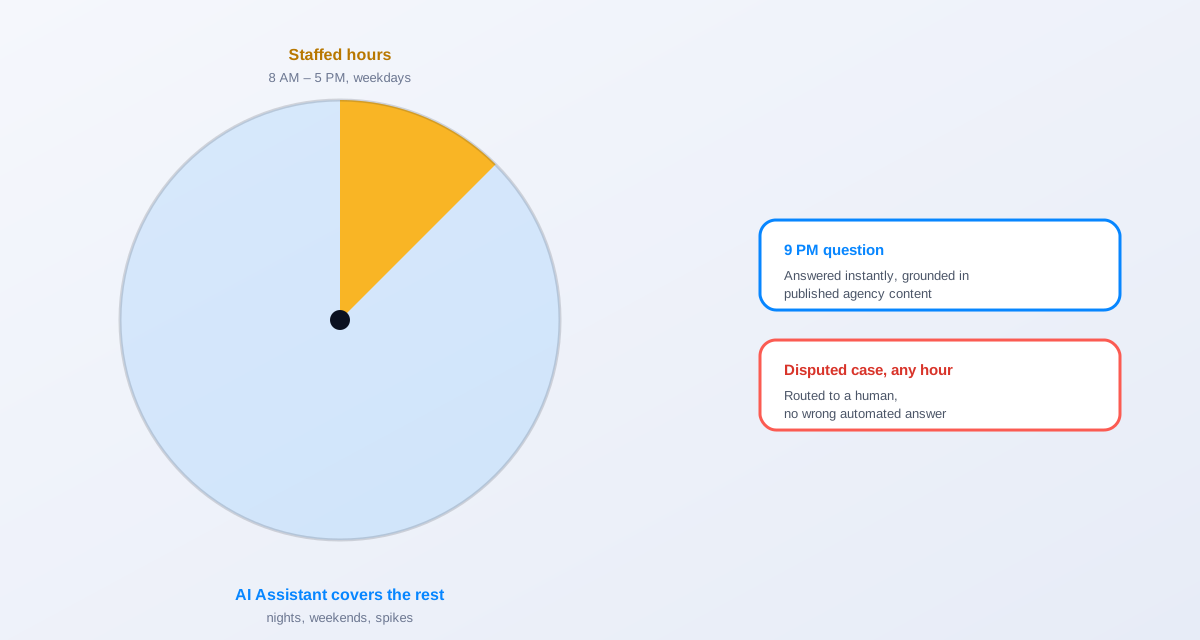
AI Assistant answers the routine third: questions with answers that already exist somewhere in your published content, your FAQ pages, your program descriptions, your service pages. It doesn't guess. It's grounded in your agency's own content, cites the source, and hands off to a human whenever a question falls outside what it can answer with confidence.
That handoff matters more than the automation itself. A resident asking about a disputed benefits denial at 11 PM doesn't get a wrong automated answer. They get an accurate acknowledgment that this requires a person, along with the fastest path to reach one during business hours, or an option to leave details for a callback. The goal isn't to pretend a chatbot replaces judgment. It's to make sure the routine questions never compete with the complex ones for your remaining staff's time.
We lost four positions in our contact center over two years and never got them back. The AI Assistant didn't replace those people. It absorbed enough of the after-hours volume that the staff we have left can actually focus on residents who need a real conversation.
director of constituent services, county government serving approximately 410,000 residents
Is an AI Chatbot the Same as an Automated Phone Tree?
No, and the difference is the entire point. A phone tree forces residents through a rigid menu of pre-scripted options and usually ends in either a voicemail or a dead end if the resident's question doesn't match one of the menu items. A grounded AI Assistant answers a plain-language question the way a knowledgeable staff member would, drawing on the actual content the agency has published, not a fixed decision tree someone built two years ago and never updated.
Language Access Doesn't Take a Night Off Either
After-hours coverage gets harder, not easier, when you add language access into the picture. A short-staffed call center rarely has multilingual coverage available at 9 PM even during business hours, let alone after them. AI Assistant supports over 100 languages natively, which means a non-English-speaking resident gets the same after-hours coverage an English-speaking resident does. Our guide to EO 13166 and multilingual government service covers the legal and practical framework for language access requirements in more depth.
What Happens When Call Volume Spikes Overnight
Benefits enrollment periods, tax deadlines, severe weather events: these are exactly the moments a short-staffed call center gets overwhelmed, and exactly the moments residents most need an answer fast. A grounded AI Assistant doesn't get a busy signal. It answers the thousandth question about shelter locations or filing deadlines the same way it answers the first, at the same speed, with no queue building behind it.
That matters more than it sounds like until you've lived through a spike. A call center that handles 200 calls a day comfortably doesn't suddenly handle 2,000 well just because the need is urgent. An AI Assistant grounded in your emergency and program content absorbs that surge without a hiring scramble, freeing remaining staff for residents whose situations genuinely require a person: the ones who can't be turned away because a system hit capacity.
How to Measure Whether It's Actually Working
Three numbers matter more than any satisfaction survey. Containment rate: the share of conversations the AI Assistant resolves without a human handoff. Escalation accuracy: whether the questions it hands off are genuinely ones a human should handle, not ones it should have answered itself. And time-to-resolution for the handed-off cases, since a well-functioning handoff should get complex questions to a human faster, not slower, once staff aren't also fielding routine volume at the same time.
- Containment rate: aim for 50 to 70 percent on well-grounded routine content within the first 90 days.
- Escalation accuracy: spot-check a sample of handoffs weekly early on to confirm the assistant isn't over- or under-escalating.
- Time-to-resolution for escalated cases: this should improve, not worsen, once routine volume stops competing for staff attention.
What Residents Notice First
Residents don't grade a chatbot on the technology behind it. They grade it on whether the answer they got was right and how fast they got it. The first impression matters disproportionately: a resident who gets a wrong or vague answer on their first try rarely gives the tool a second chance, and word travels fast in a small community about which government tools actually work. That's a strong argument for launching narrow and accurate rather than broad and shaky.
Staff notice something different. The first few weeks after launch, expect questions from your own team about whether the assistant is "taking their jobs." It isn't, and the fastest way to prove that is data: show staff the call volume trend for routine questions dropping while their own workload shifts toward the complex cases that actually need judgment. Once staff see fewer repetitive calls and more time on cases that use their actual training, resistance tends to fade within a month or two.
Where to Start If Your Call Center Is Already Stretched
Pull your call log data first, not your intuition. Most call centers can categorize the last 90 days of call volume by topic. That data tells you which questions actually dominate volume, which is usually a smaller list than staff expect, dominated by a handful of high-frequency, low-complexity topics.
Start the AI Assistant's grounding content with those top categories. A narrow, well-grounded deployment covering your top ten call drivers beats a broad, thin deployment covering everything shallowly. Expand from there once staff and residents both trust the accuracy of what it's answering.
One thing to check before you deploy anything
A grounded AI Assistant is only as good as the content it's grounded in. If your published FAQ pages and service descriptions are outdated or incomplete, fix that first, or fix it in parallel. Deploying a chatbot on top of stale content just automates giving residents wrong answers faster.
Related reading
If your call center is running lean and your after-hours gap is showing, book a demo and we'll show you what AI Assistant can answer from your own content today.
Ready to see it in action?
Book a demo and we'll configure Keyspider on a live sample of your content, within 48 hours.
Book a Demo