

Gartner Just Created a Market Category for What You're Already Shopping For
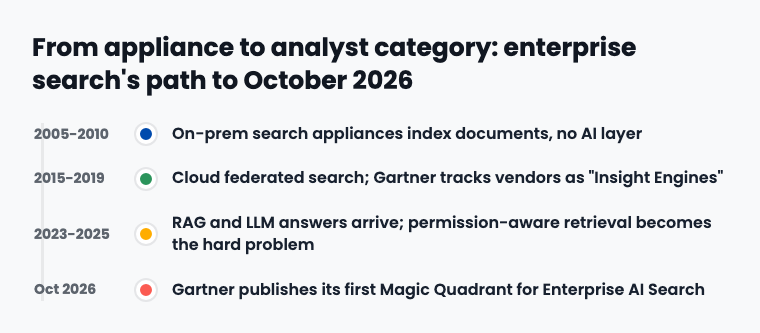
What is Gartner's Magic Quadrant for Enterprise AI Search? It's a new analyst research report, published October 2026, that evaluates vendors building AI-generated answer engines over internal enterprise content, replacing the older "Insight Engines" category that judged tools mainly on document ranking. Eleven vendors were assessed; Elastic was named a Leader.
Gartner published its first Magic Quadrant for Enterprise AI Search in October 2026. Eleven vendors got evaluated. Elastic landed as a Leader. IntraFind and Squirro came in as Niche Players. If you've been buying "search," "knowledge management," or "AI assistant" software under three different budget lines for the last five years, there's now a name for what you were actually shopping for the whole time.
That matters more than it sounds like it should. Analyst categories aren't just scorecards. They're the thing procurement officers cite in RFPs, the thing consultants use to build shortlists, and the thing a state auditor might ask about two years into a contract: "Did you evaluate this against the recognized category?" Before October, you couldn't answer that question, because the category didn't formally exist.
What changed, specifically
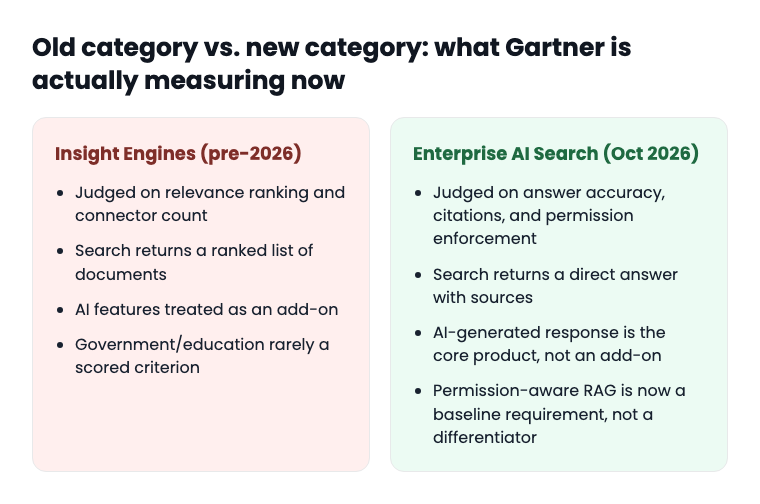
The old Gartner category, Insight Engines, measured how well a tool found and ranked documents. Good relevance scoring, solid connector counts, maybe a chatbot bolted on top. The new category measures something different: whether the system gives a direct, cited answer, whether it respects source-system permissions at query time, and whether it can do that across dozens of connected systems without a six-month indexing project.
That's not a cosmetic rename. Permission-aware retrieval, the kind where a result updates the instant someone's access changes rather than on a nightly batch job, is now the baseline a vendor has to clear just to be scored, not a line in a sales deck. Microsoft's own Copilot documentation leans on "search results remain dependent on the user's existing permissions," but the oversharing problems showing up in third-party security research prove that respecting permissions and respecting *good* permissions are two different things. Glean makes a similar permission-inheritance claim, and its compliance story stops at TX-RAMP, a Texas-only authorization, with nothing built for CJIS or FERPA-governed buyers.
The category didn't exist before October. Now it does, and it comes with a checklist you can hand a vendor instead of taking their word for it.
Where the named vendors actually stand
Elastic's Leader placement comes from the Enterprise AI Search MQ *and* a separate Everest Group PEAK Matrix nod the same month. Here's the complication worth knowing before you cite either report in an RFP: Elastic is simultaneously deprecating its own packaged Workplace Search product starting at version 9.0, pushing customers toward building on raw Elasticsearch instead. A buyer who searches "Elastic Workplace Search" today lands on a deprecation notice, not a sales page. Leader status in a point-in-time analyst report and product continuity are not the same measurement.
Lucidworks, not named a Leader in this cycle, already published its own 2026 buyer's guide treating the category shift as settled fact. Sinequa picked up five consecutive Leader placements across its analyst history, built almost entirely on a defense-and-pharma, air-gapped deployment story. None of it mentions StateRAMP, CJIS, or FERPA, because none of it was written with a county IT director or university registrar's office in mind.
Why this matters for a workplace search RFP, not just a press release
A new analyst category gives you three concrete things you didn't have in September:
- 1A shared vocabulary. "Enterprise AI search" now means something specific enough that two different vendors' sales teams will understand the same question the same way.
- 2A comparison baseline. You can ask where a vendor sits, or whether they were evaluated at all, and what that placement is actually measuring (accuracy and permissions, not just connector count).
- 3A stronger hand against vague pitches. If a vendor can't explain how they handle query-time permission enforcement, in a category where that's now table stakes, that's a disqualifying answer, not a minor gap.
Picture a mid-sized county with 14 departments, three different document systems, and an IT shop of four people fielding an unsolicited Copilot pitch from their Microsoft reseller. Before October, "is this the right category of tool" was a judgment call. Now there's a published framework to check the pitch against, and a documented list of what's supposed to be table stakes for anyone in it.
Procurement tip
Cite the category, not the vendor rank. "We evaluated this against Gartner's Enterprise AI Search criteria" holds up in an audit. "We picked the Leader" doesn't, especially if that Leader is mid-deprecation on the exact product line you bought.
Keyspider's own comparison page runs the same exercise against named alternatives, criteria by criteria, instead of asking you to take a vendor's self-description at face value. Worth bookmarking before a sales call, not after.
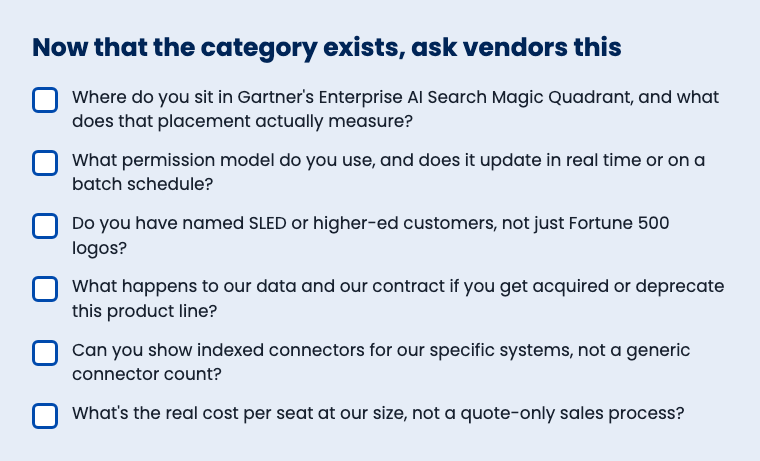
What to ask now that the category has a name
A new analyst category doesn't replace due diligence. It gives you sharper questions to run that due diligence with.
Keyspider isn't chasing a spot in this Magic Quadrant; that's a Fortune 500-scale exercise, and most named vendors have zero published content for state, local, or higher-ed buyers. What Keyspider's Workplace Search does instead is answer the same category questions directly: one search bar across SharePoint, Google Drive, Confluence, ServiceNow, and 40-plus other connected systems, role-based access that mirrors the permissions already set in each source system, and a deployment timeline measured in weeks. Why Keyspider comes down to that SLED-first focus: we built for county IT shops and university registrars, not for the enterprise logo wall Gartner's inclusion bar requires. If you're building an RFP around the criteria this category just formalized, Keyspider's buyer's guide for workplace search walks through exactly those criteria for a SLED evaluation, not a Fortune 500 one.
The harder part after picking a direction is deployment, not vendor selection. That's where a staged connector rollout plan earns its keep: sequencing SharePoint, Drive, and Confluence connectors so IT isn't running a six-month migration just to get a search bar live.
Related reading
Frequently asked questions
What is Gartner's Magic Quadrant for Enterprise AI Search?
A Gartner analyst report published October 2026 evaluating vendors on AI-generated, cited answers over internal enterprise data and permission-aware retrieval. It replaces the older Insight Engines category, which mainly scored document ranking and connector breadth.
Which vendors did Gartner name as Leaders?
Elastic. IntraFind and Squirro were named Niche Players. Gartner's report names all eleven evaluated vendors; this post isn't a substitute for reading it.
Does being left out of the Magic Quadrant mean a vendor is worse?
No. Gartner's inclusion criteria usually require minimum revenue, customer count, or market visibility. A vendor built specifically for state, local, or higher-ed buyers, a narrower market than Gartner typically targets, can be excluded and still be the better fit.
Is Keyspider's Workplace Search rated in this Magic Quadrant?
No, and we're not claiming otherwise. This report evaluates a different tier of the market. What's useful for a SLED buyer is the criteria it formalized, not the vendor rankings.
How should a state or local government buyer use this in an RFP?
Cite the category and its criteria, permission-aware retrieval, cited answers, real-time updates, rather than a vendor's rank. That language survives procurement review even if a named vendor's market position changes before signing.
What's different between "Insight Engines" and this new category?
Insight Engines scored relevance ranking and connector count. Enterprise AI Search scores answer accuracy, citation quality, and whether permissions enforce at query time instead of on a batch schedule.
Ready to see it in action?
Book a demo and we'll configure Keyspider on a live sample of your content, within 48 hours.
Book a Demo