

The One Person Who Knows Where Everything Is Just Gave Notice
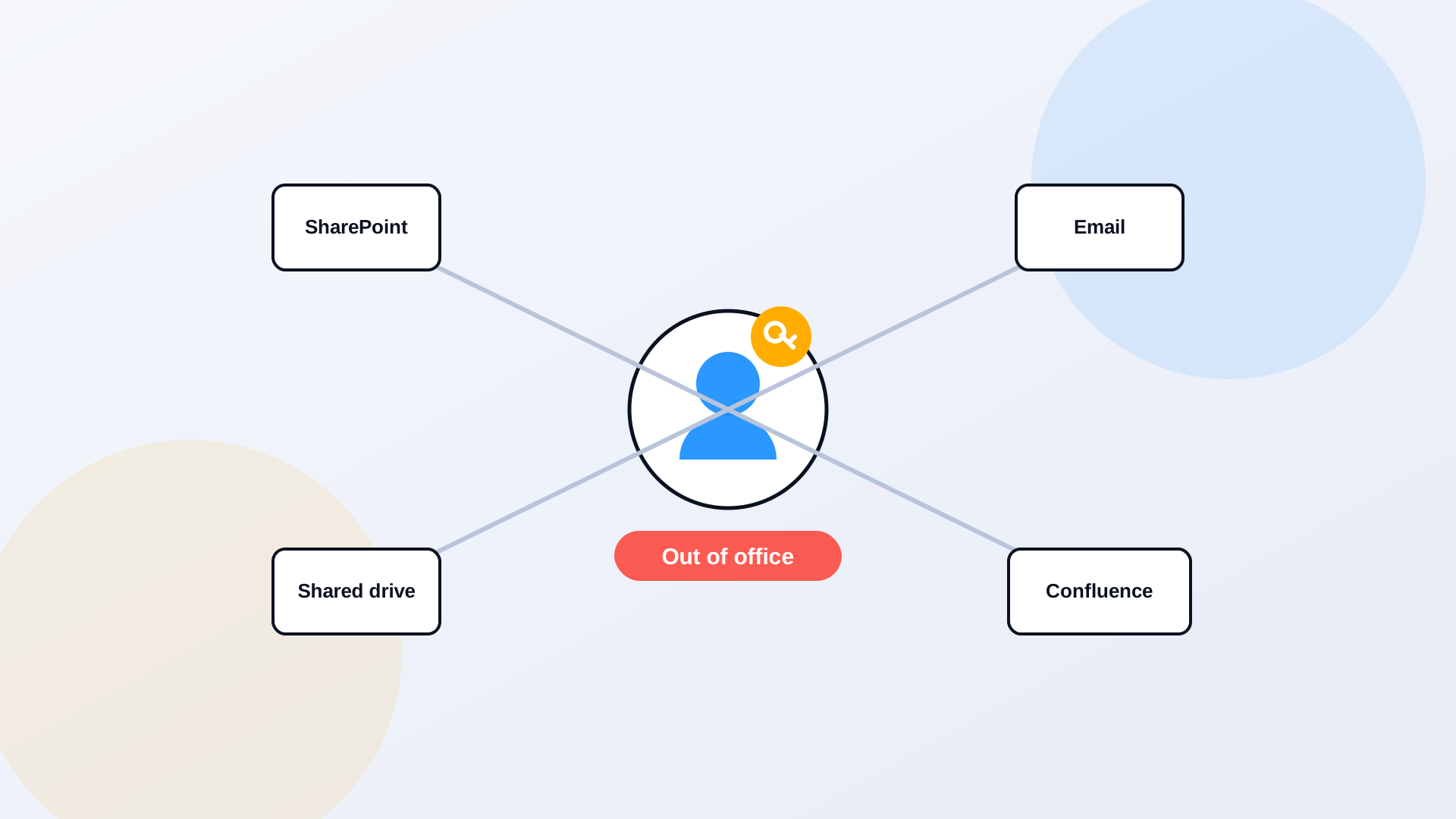
Every government office has one. The 22-year veteran who knows which form the state actually accepts, where the fiscal-year closeout checklist lives, why the permit workflow has that one weird approval step, and who to call at the county when the vendor portal breaks. Nobody wrote any of it down. It didn't need writing down, because you could just ask Dave. Then Dave puts in his retirement paperwork, and a leadership team realizes it has ninety days to extract thirty years of undocumented knowledge from one person's head, and no system built to hold it.
This is a findability problem wearing a staffing costume. The knowledge mostly exists somewhere: in a document on a shared drive, a thread buried in email, a procedure written up in Confluence four reorganizations ago. The problem isn't that it was never recorded. It's that it was recorded in fifteen different systems with no way to search across them, so the only reliable retrieval method in the building is a human being named Dave. When Dave leaves, the index leaves with him.
Why "Just Ask Dave" Was Always Fragile
The ask-Dave system works right up until it doesn't. Dave takes vacation and a permit sits for a week. Dave gets pulled into a budget crisis and the new hire waits two days for an answer that should've taken ten seconds. Dave retires and an entire function slows to a crawl while three people reconstruct what he knew by trial and error. It looked efficient because one person absorbed all the friction. The friction never went away. It was just concentrated in a spot that could quit.
And it hides the real cost. When knowledge retrieval runs through a person, nobody measures the delay, because it feels like helpfulness rather than a system failure. Studies of knowledge workers consistently find they spend close to a fifth of the workweek just looking for information they know exists somewhere. In a government office, a chunk of that fifth is walking over to Dave's desk, or waiting for Dave to reply, or reconstructing what Dave would've said.
~20%
of the average knowledge worker's week spent searching for information that already exists
5+
separate systems a typical answer might live in: shared drive, SharePoint, email, intranet, Confluence
90 days
the notice window in which agencies try to extract decades of undocumented knowledge
The Knowledge Isn't Missing. It's Unsearchable.
Walk into most agencies and the institutional knowledge is technically all there. The closeout procedure is in a Word doc. The vendor contacts are in someone's Outlook. The permit workflow is diagrammed in a SharePoint page nobody's opened since 2021. The problem is that an employee with a question has no single place to ask it. They'd have to know which of five systems holds the answer, have access to that system, and guess the right keywords. So they don't bother. They ask Dave, because Dave is the search engine that actually works.
Native search inside each of those systems doesn't solve it either. SharePoint search finds SharePoint. The shared drive has no real search worth the name. Email search only covers your own inbox, not the retiring employee's. Each silo can search itself, and none of them can search each other, which means the one query an employee actually wants, "how do we do fiscal year closeout," has no system that can answer it. We dug into why this fragmentation persists in workplace search ROI and the cost of information silos.
What Workplace Search Changes
Workplace Search indexes across the silos, SharePoint, Google Drive, Confluence, network shares, intranet pages, and lets an employee ask a plain question and get the answer, wherever it happens to live. The new hire types "fiscal year closeout checklist" and gets the document, without knowing it was filed under a project code in a subsite three departments over. No mental map of the agency's filing system required. No need to know which tool holds which answer. One search box, every source behind it.
That's the difference between knowledge that exists and knowledge that's reachable. Dave's documents were always there. What changes is that a person who isn't Dave can now find them in ten seconds instead of sending three emails and waiting two days. The institutional memory stops being a person and becomes a system, which means it stops being able to retire.
When our longest-serving planner retired, we thought we'd lose a year to figuring out what he did. We pointed workplace search at his old drives and the intranet instead. His replacement was answering her own questions in the second week, not ours.
operations manager, county planning department
Do the Capture Before the Exit Interview, Not During It
The worst time to discover your knowledge is trapped is the week someone gives notice. By then you're racing a clock, scheduling frantic handoff meetings, and hoping the retiring employee remembers to mention the thing nobody knew to ask about. A better sequence: make the knowledge findable while the person is still there to confirm it's correct. Index the systems now. Let Dave spot-check that the search actually surfaces the right closeout doc while Dave is still around to say "no, that version's outdated, here's the current one."
A quiet failure mode worth naming
Agencies often respond to a key retirement by asking the person to "document everything" in their final weeks. It rarely works. People can't enumerate what they know on demand, and the resulting doc is always incomplete. Making existing content searchable captures far more than a rushed brain-dump ever will, because it surfaces the knowledge already written down that everyone forgot was there.
This Is an Onboarding Fix, Too
The same system that saves you when Dave leaves also fixes the front end of the employee lifecycle. New hires in government routinely take months to get productive, not because the work is hard, but because the knowledge to do it is scattered and the only retrieval method is interrupting a colleague. Give a new hire a search box that reaches every system and their ramp time drops, because they stop waiting on other people to answer questions the archive could answer instantly.
There's a retention angle underneath this that doesn't get enough attention. The colleague who fields every "where is this" question, Dave, and also the person three desks down who's becoming the next Dave, spends real hours being a human help desk. Hand that load to a search system and you free up your most knowledgeable people to do the work only they can do, instead of answering the same five questions on repeat. That's covered more fully in our piece on why AI workplace search is replacing desktop search.
The Retirement Wave Isn't Slowing Down
Government has an older workforce than most sectors, and a large share of its most experienced staff is at or near retirement eligibility. Which means the ask-Dave problem isn't a one-time event you can white-knuckle through. It's a recurring structural risk, arriving on a schedule, for the next several years. Every agency will lose institutional knowledge repeatedly. The only question is whether that knowledge was made findable first, or whether it walked out the door in a cardboard box with the good stapler.
You don't need to clone Dave. You need to make sure the next person doesn't have to be him. Point search at the systems the knowledge already lives in, and the institutional memory stops depending on who's in the building that day.
Related reading
Got a key retirement on the calendar? Book a demo and we'll show you what unified search surfaces from your own systems before the notice period runs out.
Ready to see it in action?
Book a demo and we'll configure Keyspider on a live sample of your content, within 48 hours.
Book a Demo