

Search.gov Runs on Someone Else's Budget. Yours Shouldn't.
A lot of federal, state, and local websites run on search.gov and never think about it again. It's free, GSA maintains it, and it does the job well enough that nobody puts it on a risk register. That assumption is getting tested. Federal budget cycles and staffing changes across 2025 and 2026 have made it clear that shared services funded centrally aren't guaranteed forever, and search.gov is a shared service like any other.
We're not going to speculate about search.gov's specific funding status, because we don't have inside knowledge of GSA's internal budget decisions and neither does anyone writing hot takes about it. What we do know: agencies that built their entire site search strategy around a free tool they don't control have a dependency they didn't choose to have. That's worth fixing regardless of what happens to any one program.
What Happens If a Free Government Search Tool Loses Funding?
If a centrally funded shared service loses staff or budget, the practical result for the agencies using it is usually slower support, fewer feature updates, and less certainty about long-term maintenance, not necessarily an overnight shutdown. That's still a real problem for any agency that has zero fallback plan and zero in-house expertise on how their own search actually works.
The Quiet Risk of Depending on a Shared Service You Don't Control
Search.gov has been a reasonable default for a lot of agencies for a long time. It's free. It's built for government content. It doesn't require a procurement fight. Those are real advantages, and nothing here is a knock on the program or the team that built it.
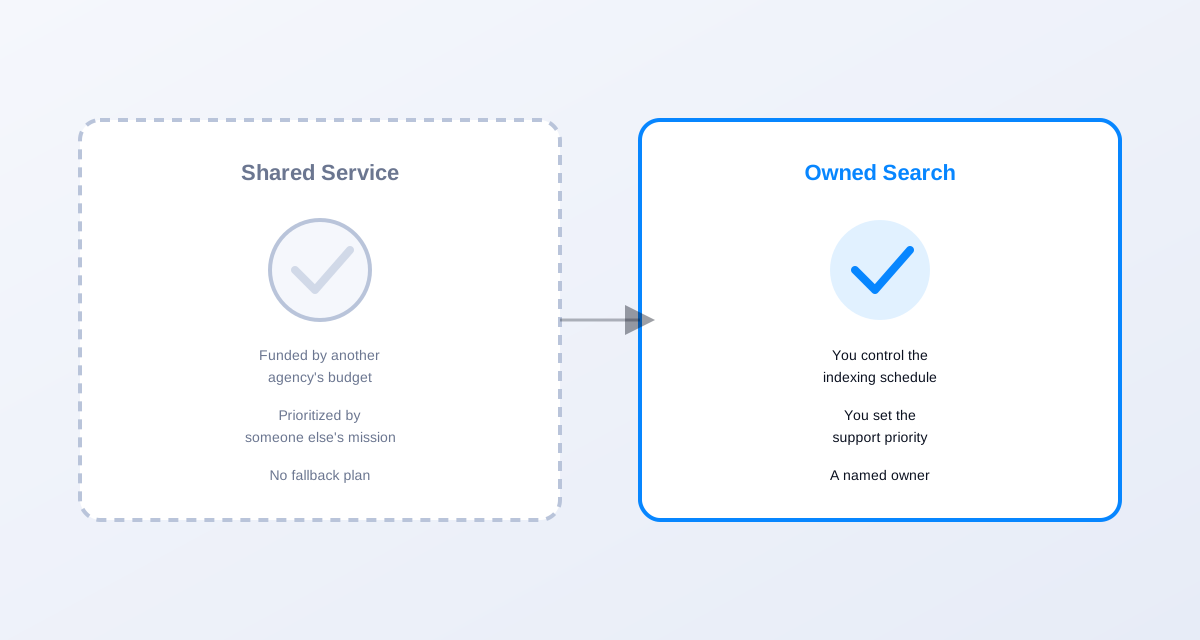
The issue is structural, not programmatic. When your site search runs on infrastructure another agency funds, maintains, and prioritizes according to its own mission, your search quality is downstream of decisions you have no say in. A staffing reduction on their side. A reprioritization. A shift in which agencies get support first. None of that shows up in your budget request, but all of it can show up in your residents' search results.
Contrast that with owning the search layer on your own site. You control the indexing schedule. You control what gets prioritized when something breaks. You're not waiting in a queue behind every other agency using the same shared tool.
What a Search Contingency Plan Actually Looks Like
A contingency plan isn't a dramatic cutover project. It's knowing, in writing, what you'd do if your current search tool stopped being reliably supported, and having that answer ready before you need it. Three things belong in that plan.
- 1An inventory of what your current search actually does well. Synonym handling, ranking logic, accessibility features, anything you'd need to replicate or improve on.
- 2A realistic timeline for switching search providers, including index build time, testing, and staff training. Most agencies underestimate this by weeks, not days.
- 3A named owner. Search touchpoints usually don't have a single accountable person, which is exactly why a funding disruption catches agencies flat-footed. Someone needs to own the answer to 'what do we do if this breaks.'
Why AI Search for Government Websites Solves a Different Problem Than Search.gov Ever Tried To
Search.gov, like most CMS-native search, is fundamentally keyword matching against an index. It does that job reasonably well. What it wasn't built to do, and what most legacy government search tools weren't built to do, is understand what a resident actually means when they type a plain-language question instead of the exact term your department uses internally.
AI Search is built around intent, not string matching. A resident searching "how do I get help paying my water bill" gets pages about utility assistance programs, even if the page itself is titled "Low-Income Household Water Assistance Program" and never uses the word "help." That's not a marginal improvement over keyword search. It's a different category of tool, and it's one every agency can control directly rather than inherit from a shared federal service.
We liked search.gov fine. But when we sat down and mapped out what would happen if support slowed down, we realized we had no plan and no in-house knowledge of how our own search worked. That was the real problem, not the tool itself.
IT director, state agency serving a population of roughly 2.1 million
The Procurement Path Is Simpler Than Most Agencies Expect
Moving off a free federal tool sounds like it should require a major procurement effort. In practice, AI Search is available through GSA MAS, NASA SEWP V, NASPO ValuePoint, and OMNIA Partners, the same cooperative purchasing vehicles most SLED and federal buyers already use for other software. That means no standalone RFP process in most cases, and a shorter runway from decision to deployment than agencies typically assume.
Deployment timelines run two to four weeks for most single-domain government sites, depending on content volume and how many legacy systems need connecting. That's fast enough to build in as a contingency without disrupting a budget cycle you've already planned around.
2–4 wks
typical deployment time for AI Search on a single government domain
38%
average reduction in zero-result searches after semantic search deployment
0
standalone RFPs required when purchasing through GSA MAS or NASPO ValuePoint
What to Check Before You Assume Your Search Tool Is Fine
Pull your own search analytics before you decide whether this is urgent. Look at your top zero-result queries from the last 90 days. If residents are searching for things your site actually has and getting nothing back, that's not a search.gov funding question. That's a search quality problem you have today, independent of anything happening at the federal level.
Search analytics also tell you what content residents are hunting for and can't find, which is a strategy input most agencies never look at. Our search analytics as content strategy post covers how to turn that data into decisions about what to publish next, not just how to fix search.
Don't wait for a crisis to build the plan
The agencies that handle a shared-service disruption well are the ones that already knew their fallback option before they needed it. Waiting until support degrades to start evaluating alternatives means making a rushed decision under pressure, which rarely produces the best outcome.
What a Migration Off Search.gov Actually Requires
Migrating search providers is not a website relaunch. It's closer to swapping the engine under a running car: the destination pages don't change, but everything that finds them does. Start with a full content inventory, every page, PDF, and document type currently indexed, so nothing silently drops out of search results on cutover day. Most vendors can crawl and build an initial index in parallel with your existing search still running live, so residents never see a gap in service.
Redirect and URL structure matter more than agencies expect going in. A competent migration plan tests the new index against your top 100 historical search queries before cutover, not after, so ranking regressions surface while the old system is still the one residents are actually using. That testing window, not the switch itself, is usually where migrations succeed or quietly go wrong.
Don't Let a Vendor Switch Become an Accessibility Regression
A search box is itself a piece of interactive UI, covered by the same WCAG 2.1 AA and Section 508 requirements as the rest of your site. Keyboard navigation through results, properly announced result counts for screen readers, and visible focus states aren't optional extras. Agencies replacing search.gov, which has a reasonable accessibility baseline, sometimes end up worse off if they don't ask a new vendor directly about search-specific accessibility testing, not just general site compliance.
- Has the search results interface itself been tested with a screen reader, not just the surrounding page template?
- Are result counts and loading states announced to assistive technology, or only shown visually?
- Does keyboard-only navigation reach every result and filter control without a mouse?
Search Is Only Half the Findability Problem
Owning your search stack also means you're not limited to whatever a shared federal service decides to build next. Residents increasingly expect to ask a plain-language question and get a direct answer, not a list of links to click through. That's a conversational layer on top of search, and it's a natural next step once the search foundation is solid. See how AI Assistant extends search into direct question answering grounded in your own published content.
Related reading
If you want to see what a contingency plan actually looks like on your own content, book a demo and we'll run AI Search against a live sample of your site.
Ready to see it in action?
Book a demo and we'll configure Keyspider on a live sample of your content, within 48 hours.
Book a Demo