

Chatbot or Live Chat? Pick Based on What the Call Actually Needs.
Every digital services director evaluating chat options for a government website eventually asks the same question: chatbot or live chat? The honest answer isn't "it depends," delivered with a shrug. It's that the two tools solve different problems, and most agencies need to know which problem they're actually trying to solve before they pick either one.
Live chat puts a real staff member on the other end of the conversation, typing responses in real time during business hours. An AI chatbot answers instantly, around the clock, grounded in whatever content the agency has published. Neither one is the universally right answer. But for most routine, high-volume, factual questions, and that's most of what government chat traffic actually is, the AI chatbot wins clearly enough that pretending it's a coin flip does agencies a disservice.
What Is Live Chat Actually Good At?
Live chat is good at judgment calls. A resident with a complicated benefits eligibility question that doesn't fit a standard category, a dispute over a permit denial, a situation where empathy and discretion matter more than speed, these are cases where a trained human on the other end of the conversation genuinely produces a better outcome than an automated response ever will.
Where Live Chat Falls Short for Most Government Use Cases
Live chat is expensive to staff at the coverage level residents expect. Most agencies can't afford round-the-clock live chat coverage, so it's available during business hours only, often with wait times during peak periods that aren't meaningfully faster than picking up the phone. A resident who opens live chat at 8 PM finds an offline message, which is functionally the same experience as no chat option at all.
There's also a volume ceiling. One staff member can handle roughly one live chat conversation at a time, maybe two with practice. That doesn't scale during a spike, tax season, benefits enrollment periods, weather emergencies, without adding headcount that most budgets don't have room for.
Where an AI Chatbot Clearly Wins
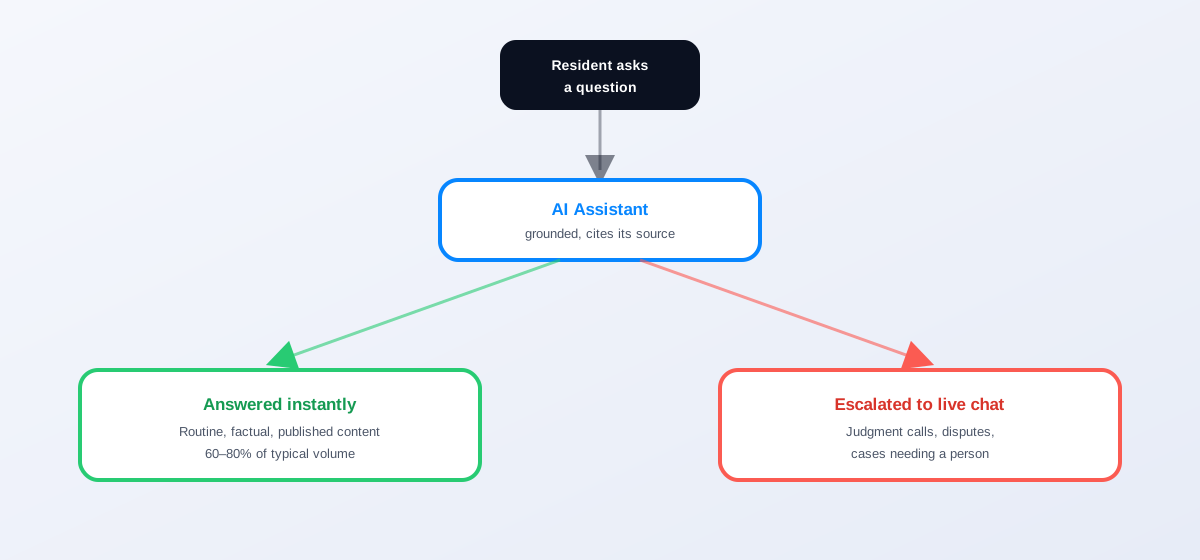
For routine, high-volume, factual questions, the kind that make up the majority of government chat and call traffic, an AI chatbot answers faster than a human can type, at any hour, at any volume, without a queue. AI Assistant draws directly from an agency's own published content and cites its source, so residents get accurate, verifiable answers rather than a generic response.
Cost per interaction is the number that tends to settle this for budget-constrained agencies. A live chat interaction, fully loaded with staff time, runs meaningfully more than an AI-handled interaction at any real volume. That's not a marginal difference. At the volumes most government websites see, it compounds fast.
1
live chat conversation a single staff member can realistically handle at once
24/7
coverage an AI chatbot provides without additional staffing cost
60–80%
of typical government chat volume is routine, factual, and answerable without a human
Do Agencies Actually Need Both?
Often, yes, but not as two competing channels. The strongest setup we see is an AI chatbot as the front door, handling the routine majority instantly, with a clear, fast escalation path to a human for anything the chatbot can't answer confidently or anything a resident specifically requests a person for. That's not compulsive balance for its own sake. It's matching each tool to what it's actually good at.
This isn't unique to government. It's how most well-run support operations across any sector are structured now. The mistake is running live chat alone and absorbing the volume ceiling and cost, or running a chatbot alone with no human escalation path and leaving residents stuck when they hit its limits.
We used to think we needed to choose. Once we saw how much of our chat volume was the same handful of questions asked a thousand different ways, the chatbot became the obvious front line. Live chat still exists, but our staff spend it on cases that actually need a person.
digital services manager, state agency
What About Multilingual Coverage?
This is where the gap between the two options widens further. Staffing live chat in English during business hours is achievable for most agencies. Staffing it in Spanish, Vietnamese, Tagalog, and whatever other languages your resident population actually speaks, at the same hours, with the same responsiveness, is a different budget problem entirely, and most agencies simply don't attempt it. AI Assistant supports over 100 languages from the same grounded content base, so the language a resident speaks doesn't determine whether they get fast, accurate help.
Executive Order 13166 and its state-level equivalents require meaningful language access for limited-English-proficiency residents. An AI chatbot that only operates in English doesn't meet that bar any better than a live chat option that only operates in English. Evaluate any chat tool, human-staffed or automated, against your actual resident language data, not an assumption that English coverage is enough.
The Budget Conversation, Honestly
Live chat cost scales with headcount and hours of coverage. Add an evening shift, add cost. Add weekend coverage, add more. An AI chatbot's cost structure is closer to flat: the same subscription covers unlimited conversations at 2 PM on a Tuesday and 2 AM on a Sunday. That doesn't make the AI chatbot free, and it doesn't mean live chat has no place in the budget. It means the marginal cost of expanding AI chatbot coverage is close to zero, while the marginal cost of expanding live chat coverage is a real, recurring staffing line.
Procurement-wise, live chat platforms and AI Assistant deployments are both typically available through the same cooperative purchasing vehicles most SLED and federal buyers already use: GSA MAS, NASPO ValuePoint, and OMNIA Partners among them. Neither option requires reinventing your procurement process from scratch, so the decision comes down to fit, not access.
What About Accuracy and Hallucination Risk?
This is the legitimate objection to AI chat in government, and it deserves a direct answer, not a dismissal. An ungrounded AI chatbot can generate plausible-sounding wrong answers, which is a real risk in a context where residents are asking about benefits, deadlines, and legal requirements. The fix isn't avoiding AI chat. It's requiring that any AI chatbot deployed in a government context is grounded in the agency's own verified content and cites its sources, rather than generating answers from general internet knowledge. Our post on AI Assistant hallucinations covers the technical mechanics of how grounding prevents this.
When Live Chat Is Still Worth Keeping
None of this is an argument for eliminating live chat entirely. Casework that involves a genuine dispute, a resident in crisis, or a decision with real discretion attached benefits from a person who can adapt mid-conversation in ways a grounded assistant, by design, won't attempt. Agencies serving populations with lower digital literacy or higher rates of complex, multi-step service needs, certain benefits programs are a good example, often keep a smaller live chat team specifically for those cases even after an AI chatbot absorbs the routine majority.
The mistake isn't keeping live chat. It's sizing a live chat team around total volume instead of around the fraction of volume that actually needs a human. Right-sizing that team after an AI chatbot launch, rather than before, tends to produce a leaner, better-paid, less burned-out live chat staff doing work that matches their training.
Making the Decision for Your Agency
Pull your existing chat or call transcripts, if you have them, and categorize the last 90 days by whether the question had a factual, publishable answer or required a judgment call. That ratio tells you more about which tool to prioritize than any vendor comparison chart. Most agencies are surprised by how lopsided it is toward the routine side.
The transition doesn't have to be all at once
Agencies with existing live chat staff don't need to eliminate the channel to deploy an AI chatbot. Start the chatbot on your highest-volume, lowest-complexity topics, measure the deflection, and expand from there. Staff time freed up from routine questions goes straight to the complex cases live chat is actually good at.
Related reading
Not sure which mix is right for your agency? Book a demo and we'll walk through what AI Assistant can handle from your own published content.
Ready to see it in action?
Book a demo and we'll configure Keyspider on a live sample of your content, within 48 hours.
Book a Demo