

DOJ Extended Your ADA Deadline a Year. Don't Relax.
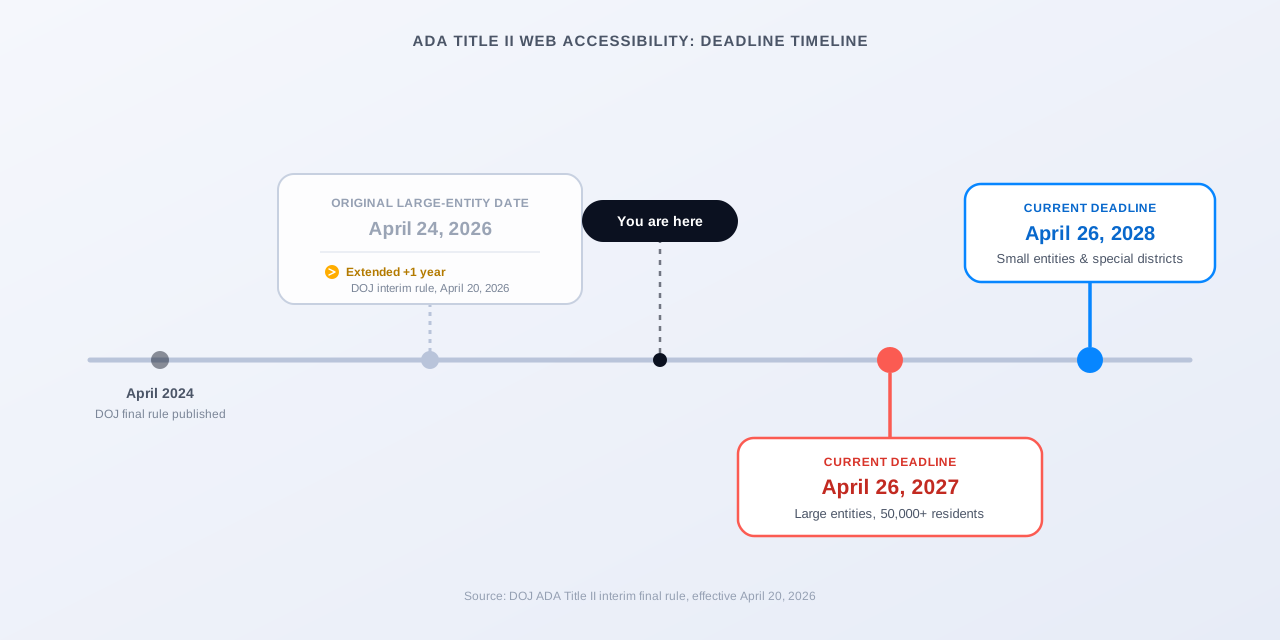
Four days before the compliance date, DOJ moved it. On April 20, 2026, with the original April 24 deadline for large public entities days away, the Department of Justice issued an interim final rule pushing every ADA Title II web accessibility deadline back by a year. Entities serving 50,000 or more residents now have until April 26, 2027. Smaller entities and special districts now have until April 26, 2028. If your agency spent the last two years racing toward April 2026, that specific date no longer matters. The obligation behind it still does.
A deadline extension is easy to misread as a reprieve from the whole rule. It isn't. DOJ didn't rescind anything, and it didn't soften the technical standard: web content and mobile apps still have to meet WCAG 2.1 AA. What changed is timing, not substance, and the agencies that treat this as permission to stand down are setting themselves up for the same scramble in 2027 that some agencies were already facing this spring.
Why Did DOJ Extend the ADA Title II Deadline?
DOJ's stated reasons, laid out in the interim final rule, center on three things: automated remediation tools can't reliably handle complex content like educational and STEM materials without human review, many covered entities, especially school districts, don't have the staffing or budget to hit the original timeline, and the 2024 rule incorporated WCAG guidance by hyperlink in a way that created legal uncertainty as that guidance kept changing underneath it. None of those reasons are about whether accessibility matters. They're about execution capacity and rule-drafting mechanics.
The rule is interim, not final. It carried a 60-day public comment window that closed June 19, 2026, which means it could theoretically still shift. In practice, DOJ has already said it fully anticipates enforcing at the new dates, so agencies planning around a further extension are planning around a low-probability event, not a likely one.
What Actually Changed, and What Didn't
The dates moved. Everything else held. WCAG 2.1 AA is still the technical standard. Content published after June 24, 2024 still needs to meet it now, not on some future deadline; that provision wasn't extended. Title II's private right of action didn't go anywhere, so advocacy organizations and individual plaintiffs can still sue over inaccessible web content today, deadline or no deadline, because the underlying nondiscrimination obligation under Title II predates this specific web rule.
That last point matters more than it sounds like it should. Agencies sometimes treat the 2024 web rule as the origin of their accessibility obligation. It isn't. It's a clarification of how an existing obligation applies to websites and apps. Losing track of the new compliance date doesn't create new exposure. Ignoring accessibility because the date moved does.
WCAG 2.1 AA
the technical standard specified in the DOJ final rule
~50
individual success criteria across the standard's four principles
20–30 min
typical manual remediation time per untagged PDF
What Large Entities Should Do With the Extra Year
Start with an honest inventory, not a defensive one. Most agencies know their website's homepage and top navigation are probably fine. The gaps live deeper: PDFs, embedded video, third-party widgets, forms built years ago by a vendor who's no longer under contract. An accessibility audit that covers the full domain, not a sample of pages, is the only way to know your actual exposure.
PDFs deserve specific attention, because they're consistently where the biggest volume gap hides. Agencies routinely have thousands of PDFs published over a decade or more: agendas, budgets, permits, benefit forms, none of them tagged for screen reader compatibility when they were uploaded. Our post on what screen readers actually see in untagged government PDFs walks through exactly what a blind resident encounters when they hit one of these documents, and it's worse than most agencies assume.
The extra year is genuinely useful if you spend it remediating. It's wasted if you spend it relieved. Prioritize by traffic and consequence: a permit application form with 40,000 annual views matters more this quarter than an archived meeting agenda from 2019. Document the remediation plan and timeline as you go. A private lawsuit doesn't care that your regulatory deadline moved to 2027; it only cares whether the page a plaintiff hit today was accessible today.
Do Smaller Entities Now Have Until 2028 to Do Nothing?
Technically, entities serving fewer than 50,000 residents and special district governments now have until April 26, 2028. Practically, that's roughly the same trap the original 2027 date set for this group before the extension landed: a deadline that feels comfortably distant right up until it isn't. A meaningful remediation project, especially one covering a large PDF backlog, takes months to plan and execute properly, and smaller entities typically have less internal accessibility expertise to draw on, not more time relative to the work required.
An extended runway is still a runway with an end
Two years sounds like a lot until you back out procurement lead time, vendor onboarding, a full-site audit, and the actual remediation work. Agencies serving under 50,000 residents should treat this extension as room to plan well, not as a reason to start later.
How AI-Powered Remediation Changes the Timeline
Manual PDF remediation runs 20 to 30 minutes per document for a trained accessibility specialist, tagging headings, adding alt text, fixing reading order, verifying with a screen reader. For an agency with a few hundred PDFs, that's manageable with existing staff over a few months. For an agency with several thousand, manual remediation alone can take years and usually requires contracted specialist labor most budgets don't have.
ADA Audit applies AI-assisted remediation to that backlog: automated tagging, structure detection, and alt text generation reviewed by accessibility specialists rather than built entirely by hand. Agencies using this approach typically clear backlogs in a fraction of the time manual remediation alone would take, and at a fraction of the cost per document. DOJ's stated reason for extending the deadline, that automated tools alone can't be trusted on complex content, is exactly why the specialist review step matters. Automation handles volume. A human still checks the work.
We had almost 6,000 PDFs going back over a decade. Manual remediation at 25 minutes each was never going to happen with our staff. AI-assisted remediation, with our team reviewing the output, got us through the backlog in under three months.
accessibility coordinator, state health and human services agency
What a Complaint Actually Looks Like
Most DOJ Title II web accessibility complaints don't start with a lawsuit. They start with a letter, or a demand letter from an advocacy organization citing specific pages and specific WCAG failures, and that's true whether or not the regulatory deadline has technically arrived yet. The agency has a window to respond, typically with a remediation commitment. Agencies that already have an active, documented remediation program in progress are in a materially different position than agencies that have nothing, deadline aside.
For a full walkthrough of what to do if a complaint actually arrives, our ADA complaint response playbook covers the response timeline, what to say, and what not to say.
What Actually Counts as WCAG 2.1 AA Compliance?
WCAG 2.1 AA is not a single yes-or-no checkbox. It's roughly 50 individual success criteria covering text alternatives, keyboard operability, color contrast, predictable navigation, and more, organized under four principles: perceivable, operable, understandable, and robust. Passing partially, say, correct image alt text but no caption compliance for video, still leaves an agency out of compliance for the content types that fail. DOJ's rule references WCAG 2.1 AA specifically, not a general accessibility gesture, and that specificity is exactly where most legacy website audits fall short.
A genuine compliance audit tests against the full criteria set across a representative sample of page templates and content types, not just the homepage. PDFs, embedded video, third-party widgets, and dynamically loaded content each need separate evaluation, because a template passing WCAG doesn't guarantee every document type published through it does too.
Is DOJ the Only Legal Exposure Here?
No. Title II complaints can come through DOJ directly, but private plaintiffs and advocacy organizations can also file suit under Title II's private right of action, independent of any DOJ enforcement action or extension. A growing number of states have layered their own web accessibility requirements on top of the federal rule, some with earlier deadlines or broader coverage. An agency tracking only DOJ's extended timeline may be missing a state-level obligation that's already in effect today.
This is one reason a documented, dated remediation plan matters regardless of which door a complaint comes through, and regardless of how far off the federal deadline currently sits. Courts and DOJ both tend to look favorably on entities that can show active, good-faith progress, even incomplete progress. Silence and no visible effort is the position that draws the harshest response, not a documented plan that's still in motion.
Building the Case Internally for Budget
The hardest part of accessibility remediation often isn't technical. It's getting budget approved for something with no immediate visible payoff, and a pushed-back deadline makes that conversation harder, not easier. "We have until 2027 now" reads to a budget committee like "this can wait," even though the work required didn't shrink when the date moved. Reframe the ask: the extension bought planning time, not less work.
Frame the ask around risk avoidance and total cost, not just a compliance date. A documented cost comparison between manual remediation labor and AI-assisted remediation, alongside the litigation exposure that exists independent of DOJ's timeline, tends to move budget conversations faster than a deadline argument alone, especially once that deadline no longer feels close.
Related reading
If you don't know the size of your PDF backlog yet, book a demo and we'll run a sample audit against your live site.
Ready to see it in action?
Book a demo and we'll configure Keyspider on a live sample of your content, within 48 hours.
Book a Demo