

Your County Speaks 40 Languages. Your Website Speaks One.
There is a resident in your county right now who needs to know if their household qualifies for emergency rental assistance. They speak Tigrinya. The county website has a Google Translate button. The phone interpreter service is available Monday through Friday, 8am to 5pm. It is Saturday evening. They do not get an answer tonight.
This is not an extreme hypothetical. It is a daily reality in every county and city government that serves a diverse population. And the population is diverse everywhere: US Census data shows that 67 million US residents speak a language other than English at home, distributed across every state, including states that don't think of themselves as multilingual.
The EO 13166 Obligation Is Real and Enforceable
Executive Order 13166 has been in effect since 2000. It requires every recipient of federal financial assistance to take reasonable steps to provide meaningful access to programs and activities for limited English proficient individuals. That is essentially every city and county government in the United States. 'Meaningful access' is not a suggestion. It is assessed against whether LEP residents can actually complete transactions and get their questions answered.
DOJ guidance has consistently held that a website with a translate button does not constitute meaningful language access when the underlying search and interactive functions remain English-only. A resident who submits a query in Amharic and gets zero results has not received meaningful access, regardless of whether the page text they land on is being machine-translated.
What Residents Actually Experience
Walk through the typical experience of a Spanish-speaking resident trying to use a county services website. They arrive at the homepage, which may or may not have a Spanish option. If it does, the translated navigation may lead to pages that have not been translated. The search bar accepts their Spanish query, returns nothing, and they are now looking at an error page in a language they do not read fluently.
If they find a phone number, they call. They navigate an English-language IVR, reach a staff member who may or may not have access to an interpreter, wait on hold if an interpreter is needed, and eventually get the information they needed 40 minutes earlier. In the meantime, your call center has handled one more call that the website should have handled.
Our Somali-speaking families have essentially stopped trying to use our website. They call the school directly now. We're fielding calls in 7 languages through a single interpreter service that costs us $90,000 a year. Most of those calls are about things that are on the website.
Communications coordinator, urban school district, Midwest
Why This Is a Different Problem Than It Was Five Years Ago
Five years ago, multilingual digital access required translated content for every language served. That meant contracting professional translators, building a translated content publishing workflow, and maintaining separate translated versions of every page as content changed. For most city and county governments, this was prohibitively expensive for more than two or three languages.
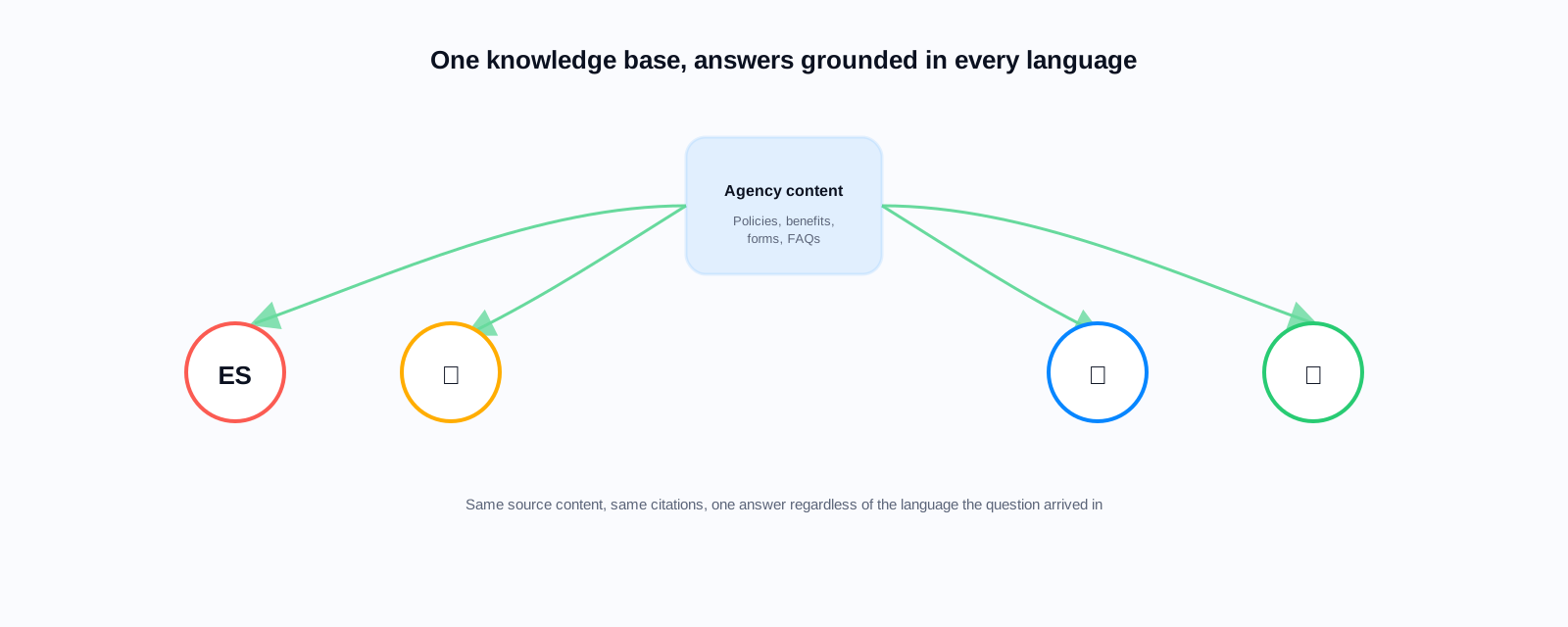
AI changes this completely. A multilingual AI Assistant that has indexed your English-language website can receive a question in any of 100-plus languages, retrieve the relevant content from your English source, synthesise it into a coherent answer, and respond in the language the question was asked in. No translated content required. No per-language maintenance burden. The AI handles the language layer at query time.
What Good Looks Like in Practice
A Tagalog-speaking parent goes to a county social services website at 9pm. She types her question in Tagalog: what documents do I need to apply for CalFresh? The AI chat assistant receives her question, retrieves the relevant application requirements page from the county's website, and responds in Tagalog with a clear list of required documents and a link to the application form.
The response is sourced from the county's own content, cited so she can verify it, and delivered in her language without any staff involvement. The citation matters: it means she can see exactly where the information came from and trust that it reflects current policy rather than outdated training data.
That interaction costs the county nothing beyond the AI subscription. The same interaction via phone interpreter costs $6–12. For a county handling 500 of those interactions weekly in non-English languages, the annual math is significant.
67M
US residents who speak a non-English language at home
44
languages spoken in one large West Coast county large enough to trigger EO 13166 obligations
$6–12
cost per phone interpreter interaction vs near-zero for AI-handled queries
100+
languages supported by Keyspider AI Assistant out of the box
24/7
availability of AI language access vs office-hours-only phone interpretation
4.2x
more likely to call the agency when a non-English speaker cannot self-serve online
Three Things That Make or Break a Multilingual Deployment
1. Multilingual Search, Not Just Multilingual Chat
The AI chat window only helps residents who find and use it. The bigger problem, the silent one, is the search bar. Most residents try the search bar before they try a chat window. If search returns nothing useful for non-English queries, residents never reach the chat at all. Multilingual AI Search, which understands queries submitted in any language and retrieves relevant English content in response, solves this upstream problem for local government and county sites alike.
2. Grounding in Your Content, Not in the Model's Memory
An AI chat tool that answers questions from its general training data rather than your agency's actual content is a liability in government contexts. County eligibility rules, application requirements, and service availability vary enormously. The AI must retrieve your content and answer from it, not from what it learned about county government generically. Grounding and citation are not optional features for public-sector AI deployments.
3. Analytics That Show You What Languages Your Community Is Using
Query analytics from a multilingual AI deployment become a real-time census of the languages your residents are actually using to seek services. That data tells you which translated content to prioritize, which language access gaps are most urgent, and how your LEP resident engagement changes over time. Agencies using multilingual AI search for 12 months have a qualitatively richer picture of their language access obligations than they had before.
The Procurement Path
Procuring multilingual AI chat for a city or county government does not require a standalone RFP in most cases. Keyspider AI Assistant is available through Carahsoft on GSA MAS, NASA SEWP V, and NASPO ValuePoint. Most state cooperative purchasing programs accept these vehicles. A legal team that has signed off on GSA MAS purchases before can usually approve a Keyspider deployment without a full procurement cycle.
Start with a multilingual pilot
Request a 30-day pilot of AI Assistant configured on your agency's actual content in your top three non-English languages. The pilot cost is typically waived for government organizations. At the end of 30 days you will have real query data showing which languages your residents are using, which questions they are asking, and what the AI is getting right and wrong.
Related reading
Next step
Check the American Community Survey data for your county (tables B16001 and C16001). Count how many languages are spoken by LEP populations of 1,000 or more. That list is your EO 13166 obligation. Compare it to the languages your website currently serves. The gap is your language access risk.
Book a demo and we'll configure AI Assistant on your website's actual content in your top three resident languages.
Ready to see it in action?
Book a demo and we'll configure Keyspider on a live sample of your content, within 48 hours.
Book a Demo