

Scope-Level Reporting
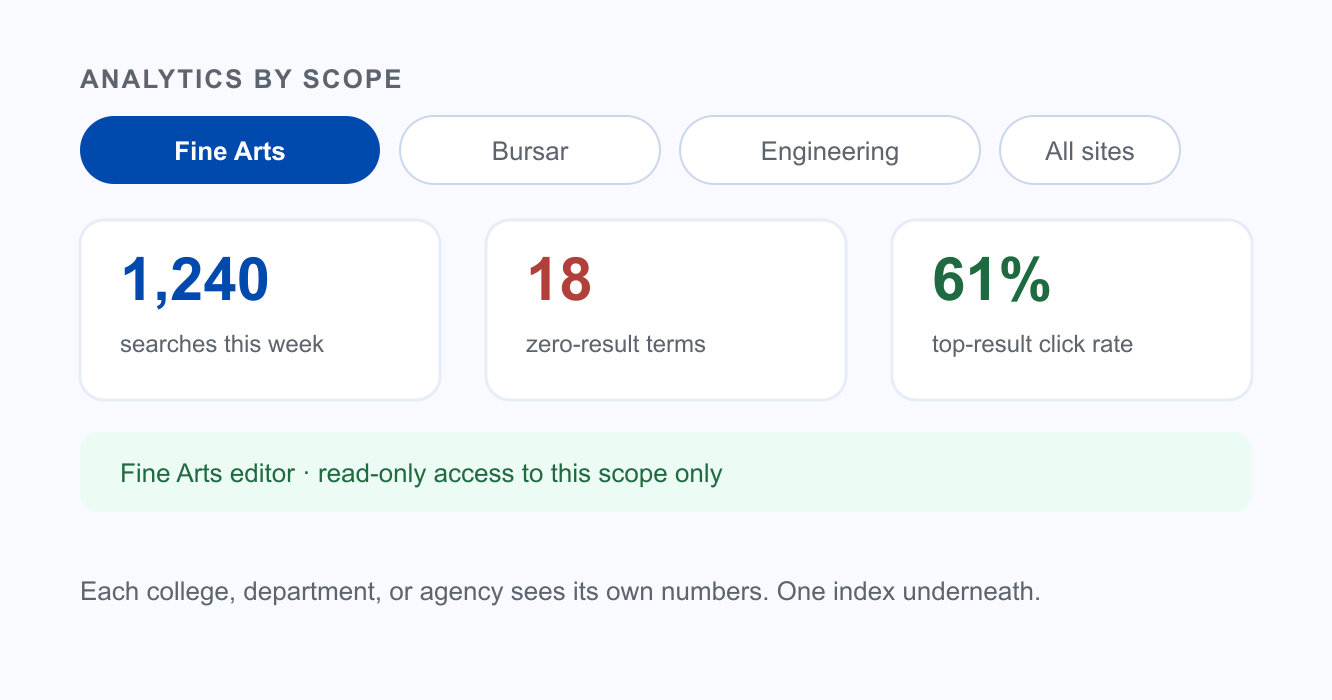
A university runs one search engine across dozens of sites, but the Fine Arts web editor doesn't care what people search on the bursar's pages. Scope-level reporting splits the data the way your organization is actually shaped. Each college, department, or agency sees its own top queries, its own dead ends, and its own click-through, without you exporting a spreadsheet for every team that asks.
How it works
Define your scopes
Scopes usually mirror your org chart: a college, a department, an agency, a campus. Each collection and subsite maps to a scope when it's set up.
Give local teams their view
Grant a department editor read-only access to their scope. They see their own searches, their own zero-results, and their own rankings, and nothing from anyone else.
Act locally, see globally
A local team closes its own gaps while central web watches the whole site. One query can ask: what were the top zero-result searches in the bursar's scope during the first two weeks of September?
Use cases
Multi-college universities
Each college owns its content and its problems. Scope reporting lets Engineering fix Engineering's search without a ticket to central IT.
County and state portals
Permitting, benefits, and public works each have their own audience. Per-scope data shows each department exactly what its residents can't find.
Shared service centers
A central web team serving dozens of sites hands each one its own dashboard instead of fielding the same 'can you pull my numbers' request every month.
Ready to give your users better answers?
AI Search, AI Assistant, and Workplace Search. Deployed in days, not months. See it live on your own content.
No credit card required · Live in 2 weeks · Cancel anytime